


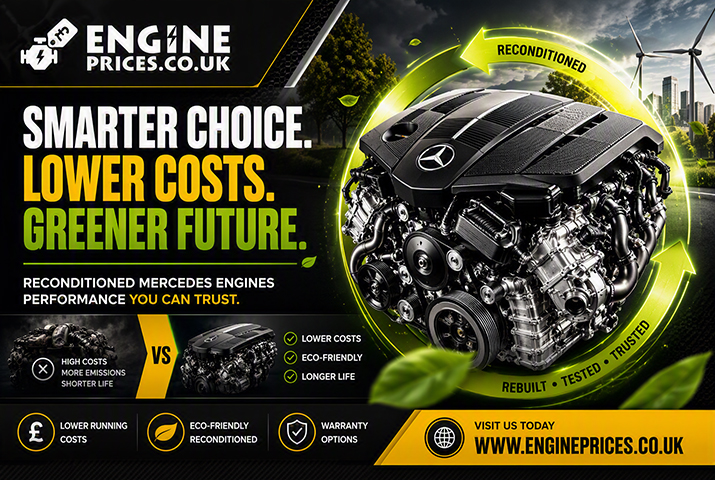
Used vs Reconditioned Mercedes-Benz Engines: Cost, Performance and Sustainability
Executive Summary
The global automotive industry is undergoing a structural shift driven by climate legislation, zero-emission urban mandates, and corporate net-zero targets. For vehicle owners, fleet operating companies, and workshop managers, this rapid shift creates a difficult operational challenge. When a modern vehicle suffers a catastrophic powertrain breakdown, the decision to scrap the entire vehicle or invest in a replacement engine involves both financial calculations and environmental lifecycle assessments.
A comprehensive view of sustainability reveals a complex picture. Scrapping an otherwise roadworthy vehicle due to an engine failure carries a massive carbon footprint from manufacturing a new car. Rebuilding or swapping the power unit is a highly effective way to participate in the circular economy, extending the vehicle’s lifespan while keeping raw materials out of industrial waste streams.
This comprehensive evaluation looks at the environmental and economic aspects of modern engine replacement. We will analyze the concept of embedded carbon, evaluate the impact of strict clean air regulations, review the chemistry of low-emission fluids, and provide a clear framework for sourcing high-quality used engines or precision-engineered reconditioned Mercedes engines to keep existing transport assets running efficiently and legally on the road.
- The Environmental Rule: The greenest vehicle is often the one that has already been built. Extending the service life of an existing vehicle chassis by installing a fresh block saves significant manufacturing energy and raw materials compared to producing a brand-new vehicle.
- The Procurement Goal: When replacing a component, sourcing a verified block with documented service records and verified emissions ratings ensures your vehicle stays fully compliant with clean air standards without high main dealer costs.
Section 1: The Carbon Footprint of Mercedes-Benz Vehicle Remanufacturing
From a sustainability standpoint, melting down metals to manufacture a brand-new vehicle chassis produces immense carbon emissions. Reconditioning an engine casting stands as an important, eco-friendly recycling practice.
[New Vehicle Factory Production]
(Massive raw material mining, battery carbon,
and high international shipping emissions)
▲
►►►► [THE CRITICAL SUSTAINABILITY SPLIT] ◄◄◄◄
▼
[Precision Engine Reconditioning]
(Reuses the heavy cast steel block, melting down
zero metal, replacing only internal wear rings)
The Material Value of Block Castings
When an engine fails, the bulk of its structural mass—the iron or aluminum cylinder block, the crankshaft, and the main cylinder head castings—remains physically sound.
- By opting for a premium reconditioned engine, specialized workshops clean, machine, and reuse these heavy castings.
- Only the high-wear internal parts like gaskets, piston rings, and main bearings are replaced with fresh components. This approach reduces the embedded carbon footprint by up to 85% compared to building a new engine from scratch.
Section 2: Choosing and Verifying the Right Mercedes-Benz Replacement Unit
When looking to swap out a failed engine with an eco-friendly approach, matching the exact engine configuration ensures the vehicle remains compliant with regional air quality requirements.
- The Compact Efficiency Standard: The M264 Turbo Four is a newer and more efficient petrol engine used across recent C-Class, GLA, CLA, and GLC-Class engines. Sourcing one of these newer blocks helps protect your vehicle’s long-term resale value.
- The Heavy-Duty Diesel Standard: The OM642 Diesel (revised version) is a popular option across ML-Class engines, GL-Class, GLS engines, R-Class, and Sprinter engines, providing excellent fuel efficiency and lower carbon footprints over long highway journeys.
- The Modern Inline-Six: For executive transport, the M256 Inline Six found in modern S-Class, GLS, and GLE engines combines modern mild-hybrid components with exceptional emissions control, making it an excellent replacement block that balances luxury refinement with strong dependability.
Section 3: Avoiding Emissions-Heavy Mercedes-Benz Mechanical Pitfalls
Not all replacement blocks are equal when it comes to long-term emissions durability. Independent engine builders warn against choosing early, non-revised engine models that are heavily loaded with unrefined anti-pollution components:
- Emissions-Heavy OM651: This specific version is overloaded with emissions systems that often fail under severe driving conditions, which can lead to high workshop repair bills.
- Early Emissions-Era M102: Early production models featured weak timing components and unrefined catalytic systems that can cause reliability issues and make it difficult to pass modern vehicle emissions tests.
- Early OM642 Models: These are prone to swirl flap failures and chronic oil cooler leaks before the redesign, which degrade combustion efficiency and cause visible exhaust smoke if not fully updated.
Section 4: The Strategic Sourcing Protocol
To successfully integrate a replacement block into an existing vehicle chassis while protecting the environment and your budget, follow this strategic sourcing framework:
- Verify the Lubrication Records: Ensure the donor vehicle was maintained using approved high-quality Mercedes-Benz engine oil UK to prevent internal sludge buildup and protect mechanical longevity.
- Inspect the Exhaust Hardware: Check that all oxygen sensors, particulate filters, and turbocharger turbines are clean and functioning normally.
- Get a Quote: Before starting a major repair project, always seek options from verified supply yards to compare the pricing of a low mileage used Mercedes Sprinter engine against a fully warrantied reconditioned engine. This ensures you make the most cost-effective and environmentally sound choice for your vehicle.
Frequently Asked Questions (FAQs)
1. What is the most reliable engine ever made for this brand?
The M113 V8 is widely regarded as the most reliable engine, known for exceptional longevity, simple design, and minimal failures across the CLS, S-Class, SL, and certain G-Class engines.
2. Which engines should be avoided when buying used?
Avoid early M272 and M273 engines due to balance shaft and timing issues, and early OM651 and OM642 diesels due to injector and swirl flap problems.
3. Are the diesel engines reliable for long journeys in the UK?
Yes, engines like the OM617, OM606, and OM648 are known for exceptional durability and handle long-distance motorway driving conditions exceptionally well.
4. What engine lasts the longest under proper care?
The OM617 diesel is famous for reaching over 500,000 miles, and many survive over a million miles with proper maintenance.
5. Which layout is best for motorway driving?
The OM648 diesel and M256 inline-six are both excellent for long-distance cruising thanks to strong torque and fuel efficiency.
6. Are reconditioned power units worth buying?
A high-quality reconditioned engine from a trusted supplier is a smart choice and can be more reliable than a high-mileage used engine.
7. What oil should be used in the UK?
Use approved Mercedes-Benz engine oil UK, typically 5W-30 or 5W-40, depending on the engine and climate. Always follow the handbook.
8. Do the timing chains last the lifetime of the vehicle?
Some engines have lifetime chains, but others like early M274, M276, and M271 require earlier inspection or replacement.
9. Which engine is best for heavy towing?
The OM642 diesel and M256 inline-six are excellent towing engines with plenty of torque.
10. Where can I get a replacement engine in the UK?
You can request information from specialized trade suppliers who offer used engines, reconditioned engines, and low-mileage imports for all vehicle models.