


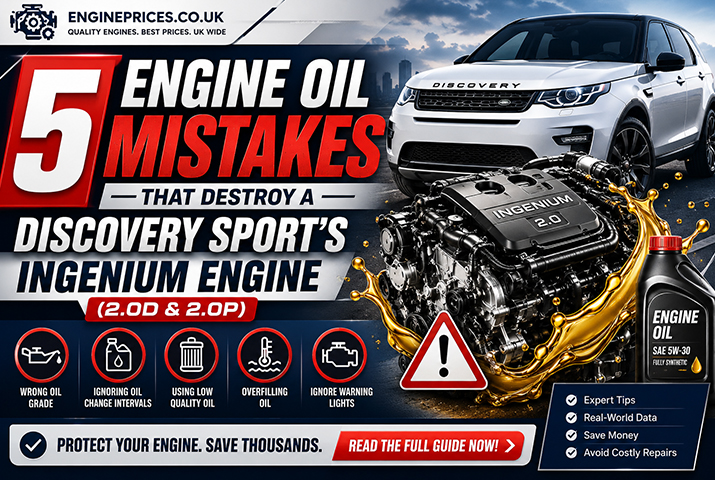
Most Ingenium engine failures on the Discovery Sport trace back to one root cause: the wrong oil in the sump. Whether it’s the 2.0-litre diesel or the 2.0-litre mild-hybrid petrol, JLR built these engines around exact lubricant chemistry, and deviating from it doesn’t just shorten service life, it actively destroys emissions hardware and turbocharger components. Here are the five mistakes that cause the most damage, and how to avoid every one of them.
Mistake #1: Ignoring the STJLR Approval Code
Plenty of engine oils on UK shelves match the correct viscosity number without matching the correct JLR approval standard. A bottle labelled ‘0W-20 fully synthetic’ isn’t automatically safe for a Discovery Sport unless it explicitly carries STJLR.5007.50, or STJLR.03.5007 for the alternative 5W-30 diesel specification.
| Engine | Only Approved Oils | Common Wrong Assumption |
| 2.0D (204DTA/204DTD) | 0W-20 STJLR.5007.50 or 5W-30 STJLR.03.5007 | “Any 5W-30 diesel oil will do” |
| 2.0P (PT204) | 0W-20 STJLR.5007.50 only | “5W-30 or 5W-40 petrol oil is fine” |
The fix is simple: check the bottle or the manufacturer’s technical data sheet for the exact STJLR code before purchase, not just the viscosity grade printed in large font on the front label.
Mistake #2: Using High-SAPS Oil Near a DPF or GPF
SAPS — sulphated ash, phosphorus and sulphur — is the chemistry that clogs particulate filters over time. Standard oils can run as high as 1.0% sulphated ash. The Discovery Sport’s low-SAPS requirement caps that figure at 0.8% or lower to protect the DPF (diesel particulate filter) on the 2.0D and the GPF (gasoline particulate filter) on the 2.0P.
- High-SAPS oil accelerates ash accumulation inside the filter substrate.
- Ash build-up raises exhaust backpressure, forcing the engine to work harder.
- Backpressure increases fuel consumption and can trigger the ECU into limp mode.
- A clogged filter is one of the most common causes of MOT emissions failure on this platform.
Mistake #3: Fitting the Wrong Viscosity in a Petrol PT204
There’s only one approved viscosity for the PT204 petrol engine: 0W-20. Owners occasionally fit 5W-30 or 5W-40 out of habit from older petrol vehicles, assuming a heavier oil offers ‘extra protection.’ In practice, the thicker oil slows oil delivery to the variable valve timing (VVT) system at cold start and increases internal friction exactly when the GPF’s low-SAPS design depends on precise, thin-film lubrication.
Reported symptoms after this mistake include rough idle, illuminated warning lights, and reduced fuel economy, with some cases progressing to forced limp mode within a few thousand miles.
Mistake #4: Overfilling or Underfilling the Sump
Correct oil capacity matters as much as correct specification. The 2.0D diesel, under both the 204DTA and 204DTD engine codes, typically takes 6.0 to 6.5 litres including the filter. The petrol PT204 carries roughly 6.0 litres dry-fill, or 5.5 to 5.8 litres during a routine service change. For a full cross-reference against other JLR engines, see the complete Land Rover engines lineup, or the dedicated 204DTA and 204DTD engine code page for exact figures by build.
| Fill Error | Consequence |
| Overfilled beyond max mark | Aeration, foaming, and reduced lubrication pressure at high RPM |
| Underfilled below min mark | Oil starvation risk to the turbocharger under load |
| Guessed rather than dipstick-checked | Both risks above, plus incorrect crankcase pressure |
Mistake #5: Overtightening the Filter Housing
Unlike older metal spin-on canisters, the Ingenium engine uses a paper-element filter inside a plastic housing. This plastic cap must be torqued to exactly 25 Nm. DIY mechanics used to hand-tighten a metal canister frequently overtighten this plastic housing, cracking it and causing a slow oil leak that can go unnoticed until the dipstick shows a critical shortfall.
- Always use a calibrated torque wrench, not a standard socket set, for the housing cap.
- Inspect the seal and housing for hairline cracks before refitting.
- After a refill, run the engine for two minutes and check for seepage before driving.
What These Five Mistakes Cost in Practice
Independent workshop pricing for a blocked DPF or GPF typically starts upwards of £1,000 once labour is included. Repeated oil starvation, meanwhile, damages the turbocharger bearings and can extend to the main engine bearings themselves, pushing repair costs toward full engine replacement territory. Even performance-oriented Discovery Sport R-Dynamic trims are not exempt from these faults if serviced incorrectly.
A warranty claim doesn’t offer a safety net here either. Dealers routinely analyse oil samples during any DPF, GPF, or turbo-related claim, and non-compliant oil is grounds for immediate rejection.
How to Avoid All Five: A Quick Checklist
- Confirm your exact engine code (204DTA, 204DTD, or PT204) before buying oil.
- Match the STJLR approval code printed on the bottle to your handbook, not just the viscosity number.
- Fill to the correct capacity using dipstick checks between pours, never a single guessed pour.
- Torque the filter housing to 25 Nm using a proper torque wrench.
- Follow a severe-condition service interval of roughly 16,000 miles for typical UK driving, rather than the extended factory schedule.
How These Mistakes Compound Over Time
None of the five mistakes above tend to cause instant failure. The danger is cumulative: one incorrect top-up barely registers, but repeated exposure across several service intervals compounds ash deposits, thins protective film at exactly the wrong moments, and slowly erodes the margin the turbocharger and particulate filters were designed with. By the time a warning light appears, the underlying damage has often been building for tens of thousands of miles.
| Mistake Frequency | Typical Outcome |
| Single incorrect fill, then corrected | Minor risk — usually recoverable with no lasting damage |
| Repeated incorrect fills across 2–3 services | Accelerated filter ash loading, measurable backpressure increase |
| Persistent wrong-spec use over years | High risk of DPF/GPF replacement and/or turbocharger failure |
Spotting Mislabelled or Counterfeit Oil
A less obvious source of these mistakes is oil that claims compliance without actually holding the correct approval. Counterfeit or mislabelled products occasionally circulate through informal resale channels, particularly around common viscosity grades like 0W-20.
- Buy from established retailers or JLR-approved suppliers rather than unverified marketplace listings.
- Cross-check the batch or approval number against the manufacturer’s official technical data sheet if anything looks inconsistent.
- Be wary of pricing significantly below the typical market rate for a genuinely STJLR-approved product.
Case Pattern: The Habitual Top-Up Trap
One recurring pattern reported by independent workshops involves owners topping up between full services with whatever 0W-20 or 5W-30 oil is convenient, rather than the exact approved product. A single top-up of the wrong grade rarely causes immediate harm, but repeated top-ups across a full-service interval can meaningfully shift the oil’s overall ash content and viscosity behaviour away from the STJLR specification the engine was designed around — effectively undoing the benefit of an otherwise correct full service.
The fix is straightforward: keep a small reserve of the correct, approved oil at home specifically for top-ups, rather than reaching for whatever is nearest at a filling station forecourt.
Checking for Existing Damage
If you’re buying a used Land Rover Discovery Sport, a quick check of its MOT history can reveal whether emissions-related faults have already surfaced, and it’s worth understanding current UK vehicle emission standards to see why regulators scrutinise DPF and GPF condition so closely during testing.
A Realistic Prevention Timeline
Prevention doesn’t require constant vigilance, just a handful of checkpoints spaced across the year. Confirm the correct STJLR specification at purchase, verify capacity and torque at every change, and review your service interval annually against your actual driving pattern rather than the factory-optimistic default. Owners who follow this simple rhythm rarely encounter any of the five mistakes covered above, regardless of how many miles the Used Discovery Sport 428PS engine eventually covers.
If the Damage Is Already Done
Ingenium engines share substantial architecture with the Land Rover Defender engine range, and the mild-hybrid 224DT diesel variant in particular depends on precise oil levels to protect its integrated starter-generator. Where turbo or engine failure has already occurred, both used engines from verified breakers and dyno-tested reconditioned engines offer more cost-effective routes than an in-vehicle rebuild, while preserving your existing DVLA vehicle tax banding.
Why JLR’s Approval Testing Is Stricter Than It Looks
JLR doesn’t simply adopt an existing ACEA category and rebrand it. Each STJLR standard is validated against the specific tolerances, coatings, and turbocharger bearing designs used in the Ingenium family, through extended-duration dynamometer testing that goes beyond the baseline ACEA sequence requirements. That’s why a generic oil meeting ACEA C5 on paper can still fall short of STJLR.5007.50 in practice — the JLR-specific validation adds requirements the base ACEA sequence doesn’t test for, particularly around long-term ash accumulation under real-world regeneration cycles rather than laboratory conditions alone.
This is also why owners shouldn’t assume that ‘meets or exceeds ACEA C5/C6’ language on a bottle is automatically equivalent to full STJLR compliance. The two overlap substantially, but only the explicit STJLR code guarantees the engine-specific validation has actually been carried out.
Mistake-Prevention FAQ
Will one oil change with the wrong oil ruin my engine?
A single change rarely causes catastrophic failure, but it accelerates ash build-up in the DPF/GPF and can affect turbo lubrication until it’s corrected at the next service.
How can I tell if my filter is already partially blocked?
Watch for reduced fuel economy, occasional warning lights, or an MOT advisory around exhaust backpressure. A workshop can measure differential pressure directly.
Is it safe to top up with a different brand mid-interval?
Yes, provided the top-up oil carries the same STJLR approval code and viscosity — brand is irrelevant, specification compliance is not.
Does overtightening the filter housing show up immediately?
Not always. A hairline crack can leak slowly over days or weeks, which is why a post-change seepage check matters as much as the torque setting itself.
How many incorrect oil changes before real damage occurs?
There’s no fixed number, but repeated use across two or three consecutive services is generally where measurable ash loading and wear risk become significant.
Can a workshop tell if the wrong oil was used previously?
Yes, oil analysis and filter inspection can reveal ash content and viscosity inconsistent with the approved specification, which is exactly what dealers check during a warranty dispute. If oil-related damage has already reached the point of no return, we can match your registration and engine code to warranty-backed replacement units from trusted UK suppliers — get quotes in seconds.