


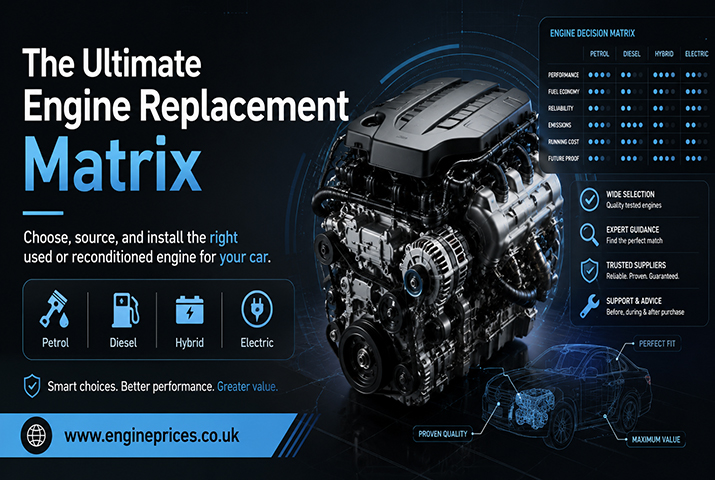
The Smart Buyer’s Engine Matrix: How to Choose Between Petrol, Diesel, Hybrid, Or Electric Replacements Without Getting Ripped Off
Executive Summary
When your vehicle’s engine suffers a catastrophic mechanical failure—such as a snapped timing chain, a threw rod, or a warped cylinder block—the sudden financial pressure can feel overwhelming. Suddenly, you are forced to make a high-stakes decision: do you scrap the car, purchase a brand-new vehicle with high monthly finance payments, or opt for a replacement engine?
For the vast majority of UK motorists, replacing the engine is the most financially viable path to restore their car’s value and extend its lifespan. However, navigating the modern engine marketplace is a minefield of technical jargon, varying quality standards, and potential scams.
This comprehensive guide serves as your executive roadmap to the automotive replacement sector. Whether you are weighing up the long-term running costs of a petrol engine versus a diesel engine, looking to transition your vehicle to an alternative hybrid engine, or trying to decide between a cheap used engine and a precision-engineered reconditioned engine, this matrix provides the exact technical blueprints, risk analyses, and purchasing frameworks you need.
- The Golden Rule: Never buy a BMW replacement engine based on price alone. A cheap, unverified salvage unit frequently carries hidden defects that can double your installation labor costs.
- The Conversion Advantage: Utilizing a trusted matching portal like www.engineprices.co.uk to locate and get a quote for a verified engine can save you thousands of pounds compared to main dealer prices.
Section 1: The Combustion Divide — Petrol vs. Diesel Replacements
Before sourcing an engine, you must analyze whether your current fuel powertrain is worth retaining, especially if you have the option to swap models within the same vehicle chassis family. The choice between a petrol engine and a diesel engine dictates not only your upfront replacement costs but also your vehicle’s long-term operational costs, emissions compliance, and driving dynamics.
+———————————–+———————————–+———————————–+
| Performance Metric | Petrol (Gasoline) Engines | Diesel Engines |
+———————————–+———————————–+———————————–+
| Average Purchase Cost (Used) | Lower (£800 – £2,200) | Higher (£1,200 – £3,500) |
+———————————–+———————————–+———————————–+
| Reconditioning Complexity | Moderate | High (due to high-pressure fuel) |
+———————————–+———————————–+———————————–+
| Average Lifespan (Maintained) | 130,000 – 180,000 Miles | 200,000 – 300,000+ Miles |
+———————————–+———————————–+———————————–+
| Low-End Torque Output | Lower (requires higher RPM) | Exceptional (from low RPM) |
+———————————–+———————————–+———————————–+
| UK Clean Air Zone (CAZ) Status | Euro 4+ Exempt (post-2006 cars) | Euro 6+ Only Exempt (post-2015) |
+———————————–+———————————–+———————————–+
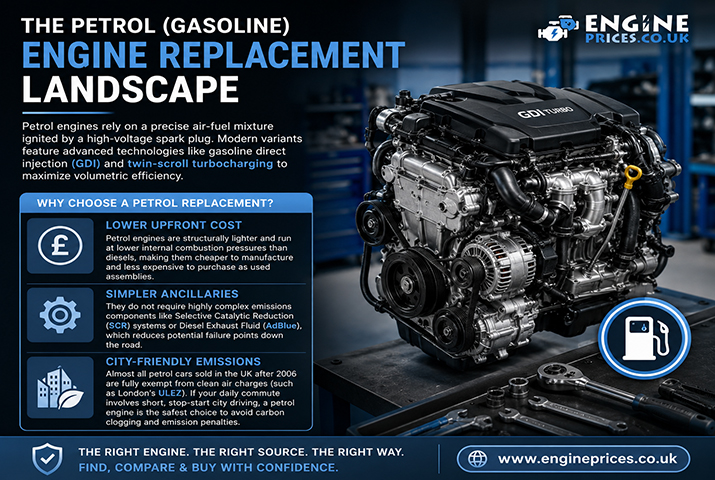
The Petrol (Gasoline) Engine Replacement Landscape
Petrol engines rely on a precise air-fuel mixture ignited by a high-voltage spark plug. Modern variants feature advanced technologies like gasoline direct injection (GDI) and twin-scroll turbocharging to maximize volumetric efficiency.
- Why Choose a Petrol Replacement?
- Lower Upfront Cost: Petrol engines are structurally lighter and run at lower internal combustion pressures than diesels, making them cheaper to manufacture and less expensive to purchase as used assemblies.
- Simpler Ancillaries: They do not require highly complex emissions components like Selective Catalytic Reduction (SCR) systems or Diesel Exhaust Fluid (AdBlue), which reduces potential failure points down the road.
- City-Friendly Emissions: Almost all petrol cars sold in the UK after 2006 are fully exempt from clean air charges (such as London’s ULEZ). If your daily commute involves short, stop-start city driving, a petrol engine is the safest choice to avoid carbon clogging and emission penalties.
The Diesel Engine Replacement Landscape
Diesel engines do not use spark plugs. Instead, they compress intake air to extreme ratios (often exceeding 16:1), heating the air to temperatures high enough to instantly ignite diesel fuel upon injection.
- Why Choose a Diesel Replacement?
- Unrivalled Efficiency and Torque: Diesels deliver massive low-end torque, making them the ultimate choice for heavy SUVs, towing, and long-distance motorway cruising.
- Exceptional Durability: The engine blocks are cast from heavy-duty materials (such as compacted graphite iron) to withstand high compression pressures, resulting in a significantly longer mechanical lifespan if properly lubricated.
- The Carbon Catch: Modern Euro 6 diesel engines are incredibly clean but are highly sensitive to short journeys. If a diesel engine is not regularly driven at motorway speeds, its Diesel Particulate Filter (DPF) and EGR valves will clog with soot, leading to restricted performance and costly workshop bills.
Section 2: The Next Generation — Hybrids, EVs, and Hydrogen
If your internal combustion engine has failed, you might be considering whether it is possible—or financially viable—to upgrade to an alternative powertrain. Let’s break down the realities of transitioning to hybrid, electric, or hydrogen units.
a. Hybrid Engines (The Practical Middle Ground)
A hybrid engine bridges the gap between traditional fuel and pure electric power by combining an internal combustion engine (ICE) with an electric motor and a small high-voltage battery pack.
- Sourcing Challenge: If your hybrid’s petrol engine fails (e.g., a Toyota Prius 1.8L engine), you can easily replace the ICE block while retaining the existing hybrid transmission and battery pack.
- The Advantage: Replacing only the combustion element of a hybrid is a highly cost-effective way to restore a high-value, fuel-efficient commuter car without paying for a brand-new battery.
b. Electric Vehicle (EV) Power Units
Electric cars replace the hundreds of moving parts in an ICE with a highly compact, incredibly durable electric traction motor powered by a massive lithium-ion battery pack.
- The Replacement Reality: EV motors are highly reliable and rarely fail mechanically. When an EV loses power or range, the culprit is almost always the high-voltage battery pack rather than the motor itself.
- The Cost Factor: Sourcing a replacement EV motor is relatively affordable, but replacing a degraded battery pack can cost anywhere from £4,000 to over £12,000, making a professional battery diagnostic vital before committing to any EV powertrain work.
c. Hydrogen Fuel Cell Engines (The Frontier)
Hydrogen fuel cell vehicles (FCEVs) combine onboard compressed hydrogen with oxygen from the air inside a fuel cell stack to generate electricity, releasing nothing but clean water vapor from the tailpipe.
- The Sourcing Reality: FCEV engines are highly specialized proprietary systems. Because hydrogen refueling infrastructure in the UK remains extremely limited, sourcing a replacement fuel cell stack outside of manufacturer-backed warranty networks is virtually impossible for independent workshops at this stage.
Section 3: Sourcing Strategy — Used vs. Reconditioned Engines
Once you have identified your engine type, you must decide which sourcing strategy fits your budget, risk tolerance, and vehicle value. This is where the difference between a “cheap fix” and a “permanent solution” becomes critical.
+———————————–+———————————–+———————————–+
| Sourcing Criteria | Used Engine (Salvage / Breaker) | Reconditioned / Remanufactured |
+———————————–+———————————–+———————————–+
| Upfront Purchase Price | Low (Typically £600 – £2,500) | Moderate to High (£1,800 – £6,000) |
+———————————–+———————————–+———————————–+
| Structural Wear Levels | Unknown (varies with mileage) | Zero (machined back to factory Tol) |
+———————————–+———————————–+———————————–+
| Component Condition | Original (used gaskets, seals, etc) | Brand-new wear components fitted |
+———————————–+———————————–+———————————–+
| Typical Warranty Coverage | 30 to 90 Days (Parts Only) | 12 to 24 Months (Parts & Labor) |
+———————————–+———————————–+———————————–+
| Total Financial Risk | High (if internal faults exist) | Very Low |
+———————————–+———————————–+———————————–+
Option A: Sourcing a Used Engine (The Budget-Conscious Route)
A used engine is an engine extracted directly from a donor vehicle—usually a car that has been written off due to rear-end or side-impact cosmetic damage, leaving the front engine bay completely untouched.
- The Pros: It is by far the most affordable way to get your car back on the road. If your vehicle is only worth £3,000, installing a £2,000 reconditioned engine makes no financial sense. A £700 used engine is the logical solution.
- The Cons: You are buying an unknown quantity. While reputable breakers will verify the mileage, you cannot inspect the internal health of the piston rings, oil pump, or bearing shells without dismantling the block.
- How to Protect Yourself: Always buy from a seller that offers a minimum of a 90-day parts warranty. Before installing the engine, have your mechanic perform a leak-down test and inspect the oil pan for any signs of metallic debris.
Option B: Sourcing a Reconditioned Engine (The Zero-Risk Route)
A reconditioned engine (or remanufactured engine) has been completely stripped down to its bare bare-metal block . Every single component is chemically cleaned, measured, and inspected against original manufacturer specifications.
- The Process:
- The cylinder walls are honed or re-bored.
- The crankshaft is dynamically balanced and micro-polished.
- The cylinder head is pressure-tested and skimmed to guarantee absolute flatness.
- Brand-new pistons, rings, main and rod bearings, timing chains/belts, and valve stem seals are installed.
- The Pros: The engine is effectively restored to 0-mile factory condition, delivering original performance, fuel economy, and reliability. It is backed by a comprehensive 12 to 24-month warranty that often covers labor costs.
- The Cons: The upfront purchase price is significantly higher.
- Who is this for? If you own a high-value family car, a premium sports car, or a commercial work van that you intend to keep for several years, a reconditioned engine is a highly smart investment.
Section 4: Engine Configurations — Layouts and Fitment Concerns
When replacing an engine, you cannot simply buy any unit with the same displacement (e.g., a “2.0L engine”) and expect it to fit. The physical engine configuration and layout must match your vehicle’s engine bay architecture exactly.
1. Inline (Straight) Engines
Cylinders are arranged in a single vertical row.
- Common Use: Found in almost all four-cylinder hatchbacks and saloons, as well as BMW’s iconic straight-six engines.
- Sourcing Tip: Inline engines are compact and highly accessible, making them relatively easy to extract and install, which keeps workshop labor costs low.
2. V-Type Engines (V6, V8, V10)
Cylinders are arranged in two angled banks forming a “V” shape connected to a single crankshaft.
- Common Use: Found in high-performance sports cars, larger executive saloons, and heavy-duty SUVs.
- Sourcing Tip: V-engines are wide and highly complex. Replacing a V-engine often requires dropping the entire front subframe, which significantly increases the number of labor hours billed by your garage.
3. Flat (Boxer) Engines
Cylinders lie horizontally flat in two opposing rows, moving horizontally like two boxers punching.
- Common Use: Exclusively used by Subaru and Porsche.
- Sourcing Tip: Boxer engines provide a highly desirable low center of gravity, but they are wide and require highly specialized knowledge to align and seal correctly during installation. Always ensure your chosen mechanic has specific experience working on flat-four or flat-six blocks.
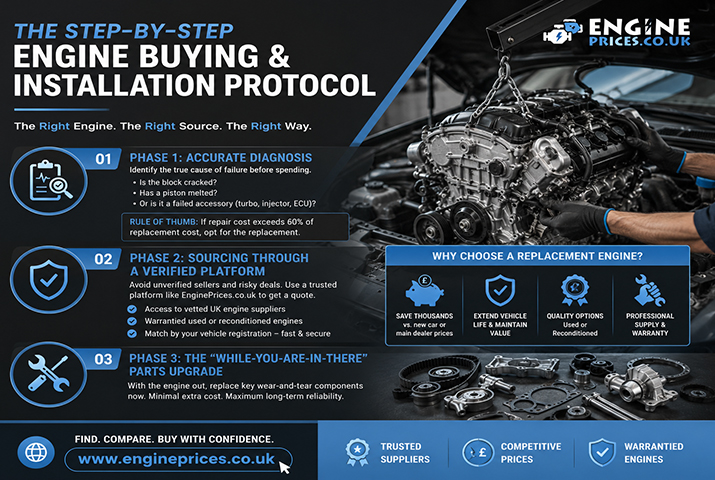
Section 5: The Step-by-Step Engine Buying & Installation Protocol
To ensure your engine swap is a complete success, you must follow a structured, professional protocol from the moment of diagnosis to the first turn of the key.
Phase 1: Accurate Diagnosis
Before condemning your current engine, ensure your mechanic has identified the exact cause of failure.
- Is the block physically cracked?
- Has a piston melted?
- Or is the issue simply a failed accessory (like a blown turbocharger, a faulty fuel injector, or a bad ECU) that can be replaced for a fraction of the cost of a full engine swap?
- Rule of Thumb: If the repair cost of your original engine exceeds 60% of the cost of a replacement unit, opt for the replacement.
Phase 2: Sourcing through a Verified Platform
Avoid buying engines from unverified social media listings or private classified ads. If the engine is defective, you have virtually zero legal recourse to get your money back.
- The Secure Method: Use a reputable platform like www.engineprices.co.uk to get a quote. They connect you with an extensive network of vetted, professional UK engine suppliers. This ensures you receive a high-quality, warrantied used or reconditioned engine that matches your exact vehicle registration number, saving you hours of searching and protecting you from fraudulent sellers.
Phase 3: The “While-You-Are-In-There” Parts Upgrade
When your mechanic has the engine completely removed from the car, they have unprecedented, easy access to components that are normally buried deep within the engine bay. Replacing these wear-and-tear items now costs virtually zero additional labor.
The Essential Pre-Installation Checklist:
- Brand-New Clutch (Manual Cars): If your car has covered over 70,000 miles, replace the clutch friction plate, pressure plate, and dual-mass flywheel now.
- Water Pump & Thermostat: Plastic water pump impellers degrade and split over time. Installing a fresh, metal-impeller unit prevents future overheating.
- Rear Main Crankshaft Seal: This seal sits behind the flywheel. If it leaks later, you have to pull the entire transmission to change a £15 rubber part. Replace it proactively now.
- Engine Mounts: Heavy engine vibrations wear out the rubber mounts. Installing fresh polyurethane or OEM rubber mounts restores cabin refinement.
Phase 4: Post-Installation Commissioning (The First 500 Miles)
How you treat your replacement engine during its first few hours of operation dictates its long-term reliability.
- The Primes: Before starting a replaced engine for the first time, your mechanic must disable the ignition or fuel pump and crank the starter motor in 5-second bursts. This builds up oil pressure throughout the block and oil lines, preventing a dry start that would instantly score the new bearing shells.
- The Break-In Period: For the first 500 miles:
- Do not exceed 3,500 RPM.
- Do not drive at a constant, fixed speed (like cruise control on the motorway) for long periods; varying the engine load helps the new piston rings seat perfectly against the cylinder walls.
- After 500 miles, perform a complete oil and filter change to flush out any microscopic metal shavings produced during the initial seating process.
Frequently Asked Questions (FAQs)
1. Is it cheaper to rebuild my original engine or buy a replacement?
In most cases, buying a replacement used or pre-reconditioned engine is significantly cheaper and faster. Rebuilding an engine from scratch requires your mechanic to manually dismantle, clean, machine, and reassemble every single component, which can take 20 to 40 hours of highly expensive specialist labor. A replacement engine can simply be unbolted, swapped, and bolted back in, reducing workshop downtime to a matter of days.
2. How long does a typical engine replacement swap take?
For a standard front-wheel-drive hatchback with an inline four-cylinder engine, a professional garage can complete the swap in 8 to 12 hours of labor. For complex all-wheel-drive (AWD) vehicles, heavy SUVs, or large V-engines, the process is highly involved and can take anywhere from 15 to 25 hours.
3. Will a replacement engine affect my car’s insurance premium?
If you are replacing the failed engine with an identical unit of the exact same code, size, and specification, it is considered a standard maintenance repair and will not affect your insurance premiums. However, you must notify the DVLA of the new engine’s serial number so they can update your vehicle’s V5C logbook. If you are swapping to a different engine size or type, you must notify your insurance company immediately, as this is classified as a modification.
4. What does a warranty on a used engine actually cover?
A standard used engine warranty from a breaker yard is typically a “parts-only” warranty lasting 30, 90, or 180 days. This means that if the engine fails internally within the warranty window, the seller will supply a replacement block or refund your purchase price. However, they will not cover the cost of the labor charged by your garage to remove the failed engine and install the second unit. To protect against this, consider purchasing an extended warranty that includes labor coverage.
5. Can I swap a petrol engine for a diesel engine in my car?
While physically possible because different models of the same car chassis often share engine bay dimensions, this swap is a financial and technical nightmare. You would need to replace not only the engine, but also the transmission, the fuel tank, the fuel lines, the entire instrument cluster, the exhaust system (including catalyst and filters), the wiring harness, and the engine control unit (ECU). It is almost always far cheaper to sell your car and buy a factory-built diesel model.
6. How can I verify the mileage of a used engine before buying?
Always ask the seller for the REG or the registration number of the donor car. You can then run a free online MOT check or vehicle history check in the UK to verify the exact mileage of the donor car at its last MOT test, giving you independent confirmation of the engine’s true wear levels.