


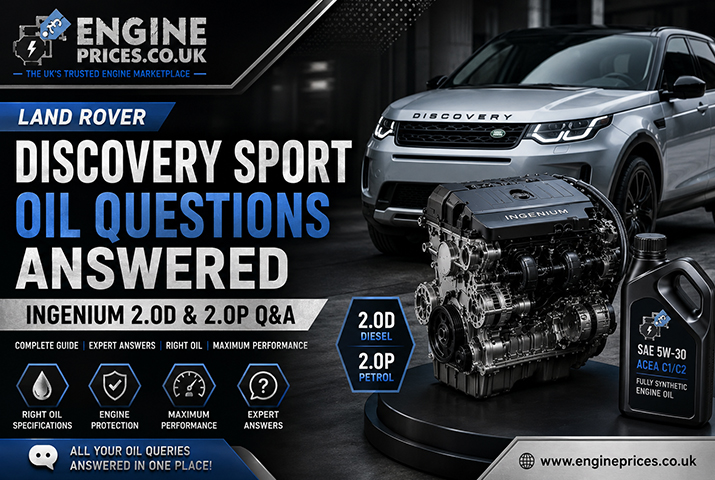
This page answers the specific questions Discovery Sport owners search for most: what oil the Ingenium 2.0 diesel and used Land Rover 2.0 petrol engines need, how much to put in, and why getting either answer wrong can be an expensive mistake. Each answer stands alone, so jump straight to the question you need.
What oil does a Discovery Sport 2.0D diesel need?
The 2.0-litre diesel Ingenium, covering both the 204DTA and 204DTD engine codes, is approved for either 0W-20 meeting STJLR.5007.50 or 5W-30 meeting STJLR.03.5007, roughly equivalent to ACEA C5/C6 and C3 respectively. Which one applies depends on build year and whether mild-hybrid assistance is fitted — check your handbook or filler cap to confirm.
What Oil does a Discovery Sport 2.0 Petrol need?
The 2.0-litre petrol Ingenium, under the PT204 engine code, is approved for 0W-20 meeting STJLR.5007.50 only. No alternative viscosity is approved. This specific low-viscosity, low-SAPS formulation protects the Gasoline Particulate Filter (GPF) and supports correct cold-start behaviour of the variable valve timing system.
How much oil does the Discovery Sport hold?
| Engine Code | Engine Type | Oil Capacity |
| 204DTA / 204DTD | 2.0-litre diesel | 6.0–6.5 litres (with filter) |
| PT204 | 2.0-litre petrol | ~6.0 litres dry fill / 5.5–5.8 litres service fill |
| 224DT | Mild-hybrid diesel | 6.0–6.5 litres |
Always fill in stages and confirm the final level on the dipstick rather than relying purely on the quoted capacity, since exact figures shift slightly by engine variant. A full cross-model comparison is available across the entire Land Rover engines lineup.
What does STJLR.5007.50 mean?
STJLR.5007.50 is Jaguar Land Rover’s own approval standard for an ultra-low-viscosity, low-SAPS engine oil. It guarantees the lubricant won’t clog the DPF or GPF and meets current Euro 6 emissions requirements. It’s the strictest and most current specification across the Ingenium range.
What does STJLR.03.5007 mean?
STJLR.03.5007 is the earlier 5W-30 diesel specification, broadly equivalent to ACEA C3. It’s still valid for certain 2.0D diesel builds without mild-hybrid electronics, but it is not interchangeable with STJLR.5007.50 — the ash limits and viscosity behaviour differ.
Can I use 5W-30 instead of 0W-20 in the petrol engine?
No. The 2.0 petrol engine has only one approved viscosity: 0W-20. Using a heavier oil can trigger limp mode, disrupt cold-start VVT operation, and accelerate wear, since the engine’s internal tolerances and oil galleries are engineered around the thinner grade.
Why is low-SAPS oil required at all?
SAPS stands for Sulphated Ash, Phosphorus and Sulphur. High levels of these elements form hard deposits inside a particulate filter. Standard oils can contain up to 1.0% sulphated ash; the Discovery Sport’s low-SAPS requirement caps this at 0.8% or below, protecting both the DPF and GPF from premature clogging as defined under the ACEA oil sequences.
What happens if I use the wrong oil?
- Filter blockage — ash accumulation increases exhaust backpressure inside the DPF or GPF.
- MOT failure — excessive backpressure or visible smoke is an automatic emissions fail point.
- Turbocharger wear — incorrect viscosity accelerates bearing wear under load.
- Warranty rejection — oil analysis during a claim will expose non-approved lubricant.
- Repair cost — filter replacement typically runs upwards of £1,000 once labour is included.
How often should I change the oil?
| Driving Style | Recommended Interval |
| Factory-standard, motorway-heavy | 20,000 miles / 12 months |
| JLR severe-condition schedule | 16,000 miles / 12 months |
| UK urban stop-start traffic | 10,000 miles / 12 months |
UK stop-start traffic accelerates fuel dilution and soot contamination, both of which shorten effective oil life well below the factory-extended interval.
What torque should the oil filter housing be tightened to?
Exactly 25 Nm. The Ingenium engine uses a plastic filter housing rather than a metal spin-on canister, and overtightening with a standard wrench is one of the most common DIY mistakes, frequently leading to a cracked housing and oil leak.
Does the wrong oil void my warranty?
Yes. If a Discovery Sport under warranty suffers a DPF, GPF, or turbocharger failure, the dealer will analyse the oil first. Oil that doesn’t meet the required STJLR specification is grounds for immediate claim rejection.
How do I reset the service light after an oil change?
You need a JLR-compatible diagnostic tool to access the service reset function through the ECU. There is no manual pedal-dance procedure on modern Ingenium-powered Discovery Sports — software intervention is required.
Can I check if my car already has an emissions-related fault?
Yes — the government’s MOT history checker lists prior test results, including any advisories or failures linked to emissions. It’s a useful first step before buying a used Discovery Sport, and worth pairing with a read of current UK vehicle emission standards for context on why DPF and GPF condition is scrutinised so closely.
What if my engine has already failed?
The 2.0D, 2.0P, and mild-hybrid 224DT variants share significant architecture with the rebuilt Land Rover Freelander engine range, which keeps replacement parts reasonably available. Owners facing terminal damage typically choose between used engines from verified breakers or dyno-tested reconditioned engines, both of which preserve your existing DVLA vehicle tax banding when fitted like-for-like — unlike some non-original engine swaps.
Is the petrol and diesel engine equally vulnerable to oil-related failure?
Broadly, yes, though the failure mode differs. The diesel’s DPF and the petrol’s GPF are both destroyed by high-SAPS oil, while the petrol’s dependence on precise VVT lubrication makes it particularly sensitive to incorrect viscosity at cold start. Even performance-focused Discovery Sport R-Dynamic trims see the same faults if serviced incorrectly, and a broader comparison of both engines’ long-term reliability is covered in this Land Rover Discovery engine survival guide.
What’s the difference between the 204DTA and 204DTD engine codes?
Both are 2.0-litre diesel Ingenium variants sharing the same core architecture and lubrication requirements, but they differ in output tuning and some internal revisions across build years. For a full breakdown of torque figures and known weak points, the dedicated 204DTA and 204DTD engine code guide is the most detailed source available.
Does the mild-hybrid system change the oil requirement?
Yes, in practice. Mild-hybrid Ingenium builds, including the 224DT diesel variant, generally standardise on the thinner 0W-20 STJLR.5007.50 oil to support the integrated starter-generator and faster warm-up cycles, whereas some non-hybrid diesel builds still retain the older 5W-30 STJLR.03.5007 approval.
Is the PT204 petrol engine used in any other JLR vehicle?
Yes. The same PT204 architecture is shared with the Range Rover Evoque L551 platform, which carries near-identical oil specification and capacity requirements.
What’s the real-world cost of ignoring these specifications?
Beyond the immediate £1,000-plus filter replacement cost, repeated use of incorrect oil accelerates turbocharger bearing wear and, in the worst cases, leads to full engine replacement. Reconditioned engines and used engines from verified breakers are the two most common recovery routes once damage is terminal.
Can a blocked filter be cleared without replacement?
Sometimes. A soot-blocked filter can often clear through a sustained high-temperature regeneration cycle, typically achieved with a longer motorway run. An ash-blocked filter cannot clear this way, since ash is inorganic residue left behind by high-SAPS oil and survives regeneration entirely — physical cleaning or replacement is the only fix once ash loading is significant.
How do I know if I need a dealer or an independent specialist?
For warranty-relevant work, a franchised dealer keeps the claim history clean. For out-of-warranty vehicles, an independent specialist familiar with Ingenium engines can often carry out the same service to the correct STJLR specification at a lower labour rate, provided they use approved oil and genuine or OEM-equivalent filters.
Does UK weather affect which oil grade I should use?
Not within the approved range — STJLR-approved oils are formulated to perform across the full span of UK temperatures, from winter cold-starts to summer motorway heat. There’s no need or benefit to switching grades seasonally, and doing so risks stepping outside the approved specification entirely.
Is topping up between services different from a full oil change?
Yes, and it’s an easy place to go wrong. A full service replaces essentially all the oil and the filter, whereas a top-up simply adds to what’s already there. If the top-up oil doesn’t match the same STJLR approval code, repeated top-ups across an interval can gradually shift the blend’s ash content and viscosity away from specification, even though the last full service was done correctly.
Where can I verify these specifications myself?
Your owner’s handbook and the VIN-linked parts catalogue are the most authoritative sources for your exact vehicle. Independent references, including the broader Land Rover engines lineup and the detailed 204DTA and 204DTD engine code breakdown, are useful for cross-checking but should never override what your specific handbook states for your build.
Quick-Reference Summary
- 2.0D: 0W-20 (STJLR.5007.50) or 5W-30 (STJLR.03.5007), 6.0–6.5 litres.
- 2.0P: 0W-20 (STJLR.5007.50) only, ~6.0 litres.
- Never use high-SAPS oil in either engine.
- Service interval: roughly 16,000 miles / 12 months for UK conditions.
- Filter housing torque: 25 Nm exactly.
If your Ingenium engine has already suffered irreversible oil-related damage, we connect you with the UK’s most trusted suppliers so you can compare warranty-backed replacements and get quotes in seconds, matched to your exact engine code and registration.